How to Stop Dog Leash Pulling? Comparing 3 No-Pull Options
Dog pulling on walks? We compare three popular no-pull solutions - front-clip harnesses, head collars, and choke collars - to help you choose the right solution.
Danielle Vigil
2/20/20263 min read
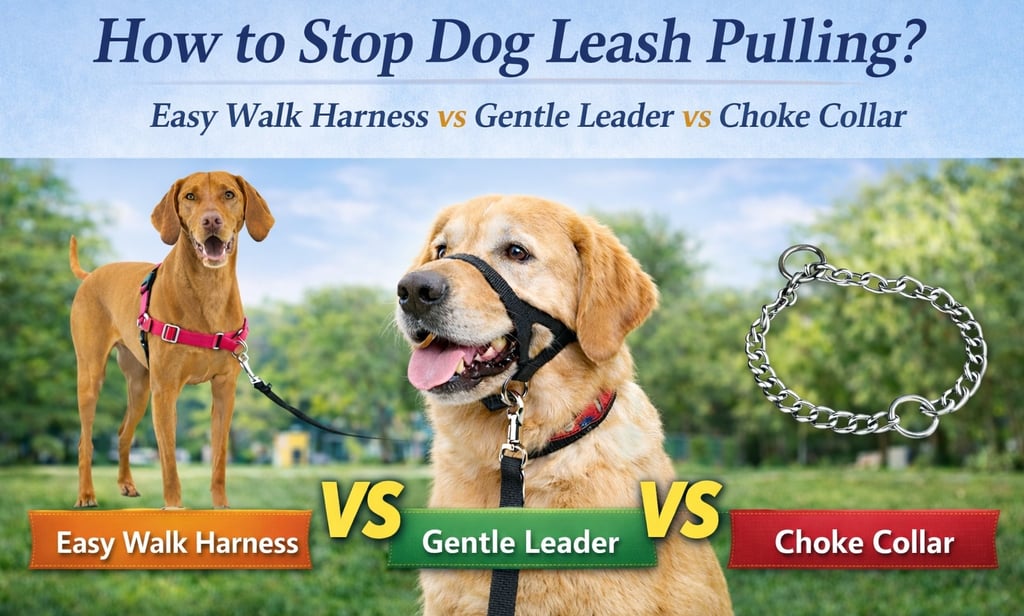
If you’ve ever been dragged down the sidewalk by an excited dog, you’re not alone. When dog owners look for “no-pull” solutions, three tools come up again and again:
Front-clip harnesses (like the PetSafe Easy Walk)
Choke collars / slip chains
Head collars (like the Gentle Leader)
But which one is actually effective, keeping safety and daily use in mind?
This guide compares them based on how well it reduces pulling, how comfortable it is, how safe it is, and how it fits into real-life training.
Important note: This post is general education, not veterinary advice. If your dog has pain, breathing issues, a history of neck injury, or severe reactivity/lunging, consult your veterinarian and/or a qualified trainer before changing walking equipment.
1) Easy Walk Harness (Front-Clip Harness)
How it works
A front-clip harness redirects your dog’s chest. When they pull, their body naturally turns toward you, making pulling less efficient.
What owners like
Noticeable improvement over a flat collar for many dogs
Many owners prefer harnesses because collars can put pressure on the neck/trachea, especially for small dogs
Some owners “upgrade” to a harness with front + back clip plus a handle for extra control
Common complaints
Some people are concerned about front-clip harnesses affecting shoulder movement/gait, especially if the dog pulls hard and constantly. You could try a Y-shaped harness as an alternative.
In chaotic moments (jumping, spinning), a simple front-clip can feel harder to “hold down.” In that case the dual-clip + handle design might work better.
Overall best for
Mild-to-moderate pullers
Daily neighborhood walks
Dogs who hate things on their face
Dog parents who want a gentle management tool while training loose-leash walking
2) Gentle Leader–Style Head Collar
How it works
A head collar gives you “steering control.” When the dog pulls, their head turns, and they physically can’t put their full body into pulling.
What owners like
Many owners say it can be a game-changer for strong pullers, sometimes more effective than an Easy Walk harness.
It can reduce the force of pulling, even if the dog still tries.
Common complaints
Acceptance: A lot of dogs initially hate wearing it, and it often requires slow conditioning.
Safety for lungers/reactive dogs: Owners worry about sudden lunges causing a sharp head/neck jerk “whiplash”.
Some trainers & owners describe it as more aversive than it looks - dogs may resist having it put on.
Overall best for
Strong pullers when you need extra steering control
Dogs who don’t lunge suddenly, or situations where you can manage distance well
Owners willing to do a proper conditioning plan, not “strap it on and go”
Quick conditioning tip
Start indoors with treats, short sessions, and lots of positivity until your dog happily “volunteers” to put their nose through the loop.
3) Choke Collars (Slip Chains)
How it works
Choke collars tighten around the neck when the dog pulls. Some people also use leash “pops” or corrections.
What owners like
They’re inexpensive and widely available
Some trainers still recommend them
Some owners believe the discomfort discourages pulling, though many dogs acclimate
Common complaints & concerns
If your dog pulls hard, a choke collar puts repeated pressure on neck structures, and can escalate frustration in reactive dogs.
They rely on discomfort/punishment to reduce pulling.
Veterinary behavior organizations warn against punishment-based tools (including prong collars) as a first-line approach due to potential adverse effects like fear, stress, and inhibited learning.
Overall best for
In general, not recommended as your first solution for pulling, especially if you have a sensitive dog, a small breed, a brachycephalic breed (Pugs, French Bulldog, Boxer, etc), a reactive dog, or you’re not working hands-on with a qualified trainer!
Tools + Training to fix leash pulling:
Equipment can reduce pulling today, but loose-leash walking comes from training: rewarding the behavior you want and preventing your dog from rehearsing the pulling behavior.
Here is a simple framework for loose-leash walking
Reward your dog for being near you / leash slack
Change direction when the leash tightens
Practice in low-distraction areas first
Gradually increase difficulty
If you want the best blend of effectiveness + comfort + safety:
Start with a well-fitted Y-shaped harness with front + back clip
Use the front clip temporarily while you train loose leash walking
If you still need more control, consider a head collar, but condition it properly and use extra caution with lungers/reactive dogs
Avoid choke collars as a first-line solution; prioritize humane, training-based approaches!
Products to try
No-Pull Harness dual clip: https://amzn.to/4aGXw2Z
Gentle Leader Head Collar: https://amzn.to/4kLrTKj
Long Line for recall training and sniffy walks: https://amzn.to/4qLMbEC
In Summary
Every dog is different. The “best” solution is the one that:
Your dog can wear comfortably
You can use consistently
Keeps everyone safe
Supports long-term training, not just short-term control!